Tuesday, 17 May 2016

Blog #3: Equality and Equity


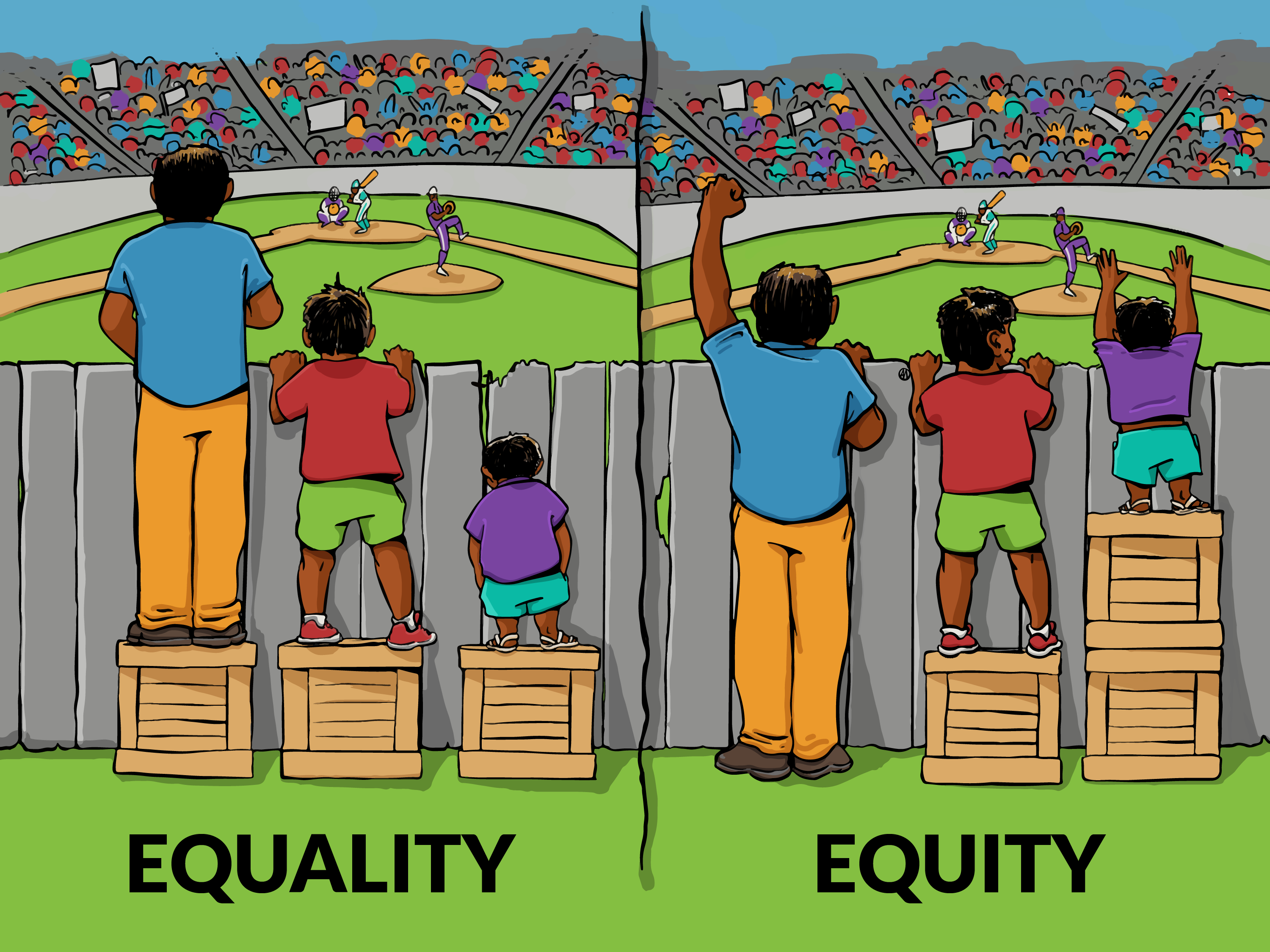
So by this time, I am so sure that many of you (seeing that millions of people are on social media by the day) have possibly seen this picture by now.
The picture depicts two scenarios in which a grown man and two boys are trying to watch a game over the fence. The man is clearly tall enough without the box to see but one side shows all three of them standing on one box each but the smallest one still can't see. The next side shows the boys sitting on an appropriate amount of boxes according to their respective heights so they can see the game just as well as the man.
Now most of my Facebooking consists of sharing a scripture, video and/or meme that I feel can get somebody thinking; if that stirs up a conversation then that's some more fruit in Jesus' Name to be grown. But when I saw this, my initial interpretation that the picture was somewhat inaccurate and refused to hit the share button.
But then after a while, I figured that my own interpretation wasn't fair either as long as I didn't remind myself what the definition of the latter word is. (Hey, I'm human just like you. I either forget things or just need to refresh myself of what I may have already learned but subconsciously)

equality ɪˈkwɒlɪti,iː-/ noun 1. the state of being equal, especially in status, rights, or opportunities. "an organization aiming to promote racial equality" synonyms: fairness, justness, equitability, impartiality, even-handedness, egalitarianism, equal rights, equal opportunities, non-discrimination;
equity ˈɛkwɪti/ noun 1. the quality of being fair and impartial. "equity of treatment" synonyms: fairness, fair-mindedness, justness, justice, equitableness, fair play;

So as I re-interpret, I think about the school system. Roughly, upon starting in Year 7, all student forms are cocktails of all abilities. As Year 9 approaches, the kids are organised according to such from top set to bottom sets in English and Maths. This is ideally in effort stimulate academic growth from the level they started without deterring anybody who might display more comfort with some of the advanced work then others who need a slightly different approach.
The twelve apostles of Jesus were all equal as far as Jesus was concerned but then in saying that they still had some specific assignments individually and with the case of James, Peter and John, He would often take them along without the others on several occasions. They all had a written contribution to the Old Testament after Paul (the writer of Hebrews to this day is anonymous); John receiving the Book of Revelations for example, so the goal was the equity of Jesus preparing the three for something He ultimately didn't need to assign to the others.
The point of the picture wasn't to make one think the ideology of equality is wrong. It has more to do with our perspective on how to act on it. So if the two kids were in the same maths exam and one of them was on learning support, the equality doesn't lie in them both starting that exam at 2pm then being expected to leave the hall by 3pm, but having the equity of setting the boy on learning support somewhere that advocated more time for them to process the same equations without the pressure only other boy is able to cope with. In the same way, the boys and the big man's common goal is to watch the game. The boys' common obstacle is the fence. The state of equality is that all three are within their rights to watch the game. The state of equity is matching the number of boxes to each boys need to reach that goal and therefore honouring the state of equality with actions.
The Bible records Jesus telling us to "Love one another as I have loved you" He died on the cross for us equally, rose three days later for us equally and is calling us all out to salvation equally. But the equity of His grace means that God uses different situations, people and the like so that every individual's opportunity to surrender is crystal clear to them. How much equity is there in how we treat each other?


About Me

My photo
Lover of Jesus Christ, an aspiring world changer. My battlefield; the world of the creative arts. This blog; a forum for opening up conversation, real talk and good vibes.

Work with Community Focus

Introducing Our New Module With Community Focus

9/01/2012

Today we met five members of the Community Focus organisation; Keithon, Lillian, Juliette, Beth and Andy. Prior to this meeting; Micheal talked with us about ideas for the February performance. Because we had only just taken down the set from our performance in November, it was agreed among everyone to keep our staging minimalistic. I suggested setting a story in an office environment. But we all jumped forward with the two ideas that Micheal and Nick came up with twogether; the upcoming 2012 Olympics and a murder mystery. Developing what we could do with the latter idea, we settled with a light-murder (as in death by the smallest & most impossible cause such as being splattered by a cream pie), making the play a pantomine comedy based on a mature theme. When we had got down to establishing a final decision about the kind of play we could do, Juliette objected to the murder angle of the detecive story, so we began to search for other crimes to solve like theft. The games we had picked out for the day was freeze tabloid, based on the scenario of Help Desk, which we as an FdA group did on the first day of our tutorial week. We also did 'Grandmother's Footsteps', a game in which only one, or even two, out of the whole group faced a wall while everyone else snuck up towards them quietly. It's only when the person turns to face them do they instantly have to keep still before they are seen, otherwise that individual has to start at the back again. This isn't the first time I've done something with a specically focused group with special needs, as I spent a day on a trip to the countryside as one of my SummerUni projects four years ago. Plus I had attended a special needs primary school. Therefore, I'm already accustomed and aware that such members of the community are as human as everyone else, as Keithon and Juliette had such a strong sense of humour while Beth could hold lengthy, insightful conversation. But today has really put me back into a pattern of communicating more closely with people with other conditions and I honestly look forward to working with them on this new module.10/01/2012As we were waiting for the arrival of Community Focus, Nick split us into two groups to give two different pitches on the crime caper story we agreed on. The focus was on the theft of the Queen's Crown Jewels. The distinction between the two groups in our presentations were this; the conspiracy being reported to the police who therefore try to warn the Queen as suspects are being questioned. The other story took place after the theft at the Queen's birthday, and show a series of interrogations in the police station. We put in as much humour in the piece as possible; the DC I was playing, taking after Clueso from Pink Panther where he's not so clever, mistakingly thinks of Queen Latifah rather than the Queen of England. In Jane's specification on who the Queen is, we broke into the national anthem. But I go too far and Jane has to cut me off. Lina and Karimah Walker took on the roles of cat burglers, but we put a twist on the term so that they are both former burglars, but Lina's character literally thinks she is a cat, thus behaves like one with the exception of answering "Because I'm a cat, you idiot!" to why she wouldn't speak when spoken to. Wealso thought it would be funny to have Sophia and Mel the servants each have one posh name and a posh slang while with the Queen & a more ghetto sounding given name and slang when conversing with each other and other characters, albeit the Queen gives them new names because she struggles to pronounce their real names. We rehearsed them until Community Focus came to see our work. Keithon and Lillian joined the former group where I (DC Makearrests) was with Jane (the chief inspector), Lina(Trixy the Cat- former burglar), Karimah Walker(Bojer-her former accomplice), Regan (the Queen) and Mel & Sophia (the Queen's servants & the real thieves) as the other members joined Charlie, Dwayne, Elisha, Venice, Simone, Karimah Farrell and Eva. Their additions allowed expansion in the cast. Keithon took on the role of another chief inspector alongside Jane's character and Lillian replaced Regan as the Queen (since she perfectly resembled her) and Regan became her loyal servant. Adding to the comedy element was including of some the real Queen's dogs on the invitation list to the ball, which we didn't show due to time spent on the scenes we did have. We therefore had to patch things up with simply revealing two of the servants as the real conspiring thieves as a cliffhanger as to whether Bojer and Trixy will be unfairly charged.At the end of the day, after watching both performances, Nick picked out characters from each of them that will be preserved for the final February play and even suggested changes to some parts; Jane & Keithon as the chief inspectors, my character will originate from Jamaica (because I was wearing a Jamaica t-shirt on this day), Trixy and Bojer, Lillian as the Queen, the unfaithful servants, the other group; Charlie & Andy as the security guards, Beth as the getaway driver (adapting to her confinement to a wheelchair), Dwayne and Elisha as more thieves and Karimah Farrell, Lekhani & Juliette as the interrogating investigators. Venice and Simone's roles as interrogators in a separate room were also changed so that they too were suspects.


Thursday, 19 January 2012
Later, we went to groups of three or four discussing central themes of the 90s, sharing our research findings and again when paired with another group. We also got a chance to go online on our phones for things we didn't find out. If anybody had facts in their notes which we also had no knowledge of, we just simply wrote those things down. For me, this was a reminder of some simple historic events and developments which were dormant in my memory. This was a simple case of not making the task complicated for myself. Some of the things discussed included;Nelson Mandela is released from prison 11 February 1990 The internet expands in 1990 The Gulf War (1990-1991)Escalation of knife crime - racist murder of Stephen Lawrence in 1993The National Lottery was launched in 1994 Downsizing of mobile phonesPuffa jackets came into fashion24-hour shopping is made availableSignificant happenings in the Iraq-Iran War.Death & Funeral of Mother Teresa in September 1997Britain wins Eurovision in 1997Princess Diana's death in 1997John Glen's final visit to the moon in 1998 The DVD player debuts in 1999 IN RELATION TO THEATRE;In-Yer-Face theatre


Due to a change of schedule to the Year 2's original drama piece demonstration, for which us Year 1s will have needed to assist in setting up stage, there was no session on Monday. This didn't affect me anyway because of my DSA Assesment meeting. On Tuesday, Nick brought in a Beethoven CD to prepre a waltz routine to. Present in time to sequence the dance was myself, Reagan, Charlie, Mel, Eva, Lekhani, Karimah Walker and Simone as partners respectively. We all experimented with and quickly eventually agreed on synchronizing five different steps, only two of them being repeatative. Dwayne and Jane came in as we arranged the dance according to the width space of the wooden studio, as the ladies (Reagan, Mel, Lekhani and Karimah) on one side and the Gentlemen (the reast of us) took their first positions as well as moved in single files. As observers for that time, they were able to give feedback on the progress we made and give further suggestions for improvement. After showing the waltz to Nick, he suggested that the dance must end with Beth coming from the stage left side all around, the stage followed by each couple she passes by, back to the centre stage where she may introduce the Queen of England. This was to use the wheelchair to her advantage for this scene as a kind of plot device to make way for Lillian's presense in her role as the Queen. As more of our group was coming in along with our partners from Community Focus, we had to split the waltz into two rows of couples, including the Queen. Myself and Mel taught the routine to everyone paired up who were late so they could keep up with us. Jane and Keethen devised a way of breaking the routine down into smaller steps, enabling Keethen who could only move with great effort at his own steadier pace to do the turns halfway and turn back without losing sync with the rest of the group. After the Queen is introduced, we moved into the previous opening we briefly played with last week, where a blackout will happen shocking all the guests and the lights return to reveal the Queens Crown Jewel as missing. All unchanged roles as police officers, security guards and detectives from last week came forward to announce that nobody will be allowed to leave until they have been questioned. Juliette took some control from this point and insisted on bringing forward the interrogation scenes next. As it was very long day of rehearsal, we only had time to run the interrogation of Andy and Charlie's security guard characters.Between the rehearsals with Community Focus, Fda Year 1 was working concurrently on the textual analysis of British Theatre history, with a particular focus on women & feminist theatre. Now the lecture discussions were personally beneficial for taking down notes to reflect on later, but this wasn't a huge necessity because Nick gave handout notes based on the points already raised along with photocopies from selected books. One of the handouts written by Leslie Hill, emphasized the limitations that theatre as an art form buts on the creativity itself, as calling the work a play can steer from the possibility incorporating more dance, for example, and that the term 'performance' appears in both a planned structured context and in the form of an outside political demonstration. I also think that actresses in particular were being described as slowing breaking out of the stereotypical, formalized manner societies of the pre-18th-early 19th Century, including women, would be used to seeing them; either as a sex object or a pretty face who was seen under male shadows, but not heard. Interestingly enough, the four playwrights we were tasked to look at further; Ann Jellicoe, Pam Gems, Yvonne Brewster and Carl Churchill, who have had some significant impact, great or small, in feminism where the theatre is concerned, each crossed over into the other ventures this module is exploring. This includes community theatre, for which Ann Jellico had set up what is now called the Claque Theatre in 1978. Brewster and Gems respectivaly tackles themes on the issue of race relations and sexual identity. So the work that has been set , I believe won't be as far apart as I first thought thanks to open-minded interests of the individual writers, directors and companies.Between 23rd-24th January (Monday and Tuesday), a lot of changes were made to the little piece that we had for our caper performance; it was clear that we had too much police forces and security between twenty one performers. So the outline was made simple; Jane & Keethan were chief inspectors representing Scotland Yard, Lekhani & Juliette were intarrogators and Charlie, Andy & Dwayne played the security guards. Grant's role as Prince William was changed again so that he portrayed the dumb criminal, joining me, Karimah Farrell (respectively as the hyper murder obsessed & the brawny burglars who slaps them, which with Grant's character where shuffled around for experimentation), Eva (the brainy one who gave ideas) & Simone (the horrible leader to whom the brawny burglar acts as second-in-command but fears her). Trixy the Cat Burglar was removed from the story, two sequences of servants cleaning the throne room, portrayed by everyone, were added, sandwiching the security guards' inspection of the room between them and we attempted to sing the British National Anthem. Now this was a stumbling block because most of us just generally didn't know the song (much to Nick's annoyance) or, in my case, couldn't remember all the lyrics.


30/01/2012-02/02/2012
30th January: As there was still an issue with who the criminals were, Reagan standing in for Simone as the Leader, rearranged the group so we had; SOPHIA as Polly Pickapocket - an exellent thief, who actually lifts the crown off the Queen's head ELISHA as Honey Trap - a beautiful women who uses her beauty to ensnare men to do whatever she wants. She flirts with Dwayne the head of security as a distraction. RHIANNA as Miss Sparkles - an electronics expert who blows the fuse of the whole palace allowing Polly to take the crown jewels unseen MYSELF as Bill Kill - Britain's most notorious assassin who hired to only to assault and knock out the security guards, much to Bill’s annoyance BEV as Bev the Bullet – the getaway driver who transports the criminals to and from the palace. Lina also became Margaret, the Queen’s sister. 31st January; For most of the group on Tuesday, the progress built up the previous day had dropped to the extent that rehearsing the full run through wasn't without constantly pausing at certain parts and having to tweak bits each time someone had to do a stand in for another student who came in late or was completely abscent. Today we finally applied the final scene in which Grant's character Dave navigates the police and security officers to the criminal's lair. We spent 10-20 minutes sharing ideas of how to a good ending that wasn't boring, made sense and was sensational; not a simple vague display of catching the bad guys and the curtains draw, we needed a small structure to follow so we knew what we were doing and space was left for improvisation. Among the ideas given were all the burglars being handcuffed by Jane & Keithan, then Jane & Keithan taking rope or string to wrap them all up together to make the arrest easier, Lekhani asking who the actual thief was and they all respond by pointing at each other shouting out; "You took out the lights!", "You seduced the security guard!" and so on. We were also keen on playing with the coppers are fixated with idea of their names being in the newspapers for returning the Queen's crown jewels that they forget to pick them up and Beth the driver comes along and takes them without being noticed. The end result eventually came to the scene starting with all the criminals assembled in the lair with the crown jewel, arguing over who should get the largest split of the spoils because of their part in the theft; Polly Pickapockett because she lifted it off the Queen's head which was the whole point of the crime, Honeytrap because she seduced the security guard (to which Polly humourously remarks that he was gay) to get into the electrics room, Bill Kill because he beat up the security guards so he couldn't stop them after, Miss Sparkles because she blew out the fuse so they couldn't be seen and Bev the Bullet because as the getaway driver she helped them get away from the palace. The Leader, Reagan, interrupts them and declares the whole plot as her idea. In this instant, all the coppers have lined up behind her and the other criminals, noticing them all immediately insist that Reagan has the crown jewels and abandon her. She turns around and proceeds an attempt to avoid arrests. This sequence was made going towards the end of the day where all police officers; Jane, Keithan, Lekhani and Juliette & the security guards; Dwayne, Andy and Charlie run in an organised single file behind Reagan on and offstage, until every cast member joins the rally two characters at a time when we run onstage again. The chase music was provided by Nick, who updated the rewritable sountrack as we were all working in the studio. I generally feel like we've got work done on Tuesday surely, but I've particularly noticed that we probably wait too long for the multitude in our group to start at least discussing how we could add to in and tweak the project we're working on as it actually took Nick assigning somebody to lead the group in our session today to actually do something. Others may not agree, but it seems to be a factor in certain stumbling blocks we get in rehearsals occasionaly. The great thing about this community play was that the focus isn't on a strict scripted show but one that simply opens the door for what society marginizes as the less abled in this scenerio to blossom as performers adapting to their ability. There was a little glitch in communication when the noise and swearing got too much for Juliette who had to walk out to keep calm for two minutes but in conclusion, the realization of a complete story in which we as Foundation Year 1 students now need to prepare to have to improvise even on the live show for anything was worth the little setbacks. 3rd January Thursday was a much smoother ride, as we ran through the show tightening up any lose ends; the beginning scene with the ballroom dance was cut down so only the waltzing was repeated. We also added some dialouge and choreographed a single failed exit. Dana was also given a new minor role as the party organiser, anxiously trying to make good on her first assignment. She is so nervous that she goes offstage the first time needing to use the toilet It is her who now calls in the cleaners, who she is responsible for, for both sequences. The table was turned sideways so Lekhani & Juliette's DC characters sat on each side while each pair of suspects in question were in the middle directly facing the audience. The table now remains onstage for the rest of the play, appearing as the meeting place for the criminals in their lair. Instead of coming on and offstage right away to accuse each pair of suspects (except Dave who confesses the whole plot) of having a brother involved with gangs, Juliette simply moved behind them to initiate these claims. Karimah Farrell may have had to change roles again due to her abscence for most of the week, but easily reprised her last position as Regean's bodyguard, the only difference this time being that she never speaks. As Dave, Grant laid on the closing piece of humour in the play, skipping offstage behind Bev as they go to Mexico with the crown jewels, as if the two were a couple running into the sunset.


06/02/2012

All day on Monday, we were dedicated the whole day to running through our 45 minute play so that, even though we had to be open to any unexpected changes on the night, we could be as responsive to our cues as possible. We used a high chair for Lillian to sit on get up from easily. Lina sowed red fabric over it to resemble the Queen’s throne. Each of the criminal characters received a black wolly hat with the skull & bones symbol, with the exception of the Leader, Ms Sparkles & Honey Trap as Rhianna& Elisha respectively felt that the latter two characters should be signified this way as females. We didn’t have enough so Karimah& Bev couldn’t wear a hat either, but this didn’t matter.I think the only thing that went wrong was the technical glitches so that Karimah Walker’s multi-media video as the news reporter surprisingly couldn’t be included in the final show.
Post-The Room, The Revolt & The Kitchen

5th-15th December 2011
Having finished our live performance of The Room, The Revolt & The Kitchen Sink, Nick introduced to the final phase of our project with the natural extracts; filming. He gave us a walkthrough of tv filming and these studio set cameras were the standard quality of the 1990s and traditionally sitcoms in which the one stage will have already been set up and a live audience will have watched the action. The difference between the normal performance in a staged setting and screen acting is that the script is applied to screen shots, in which has much had to be seen as possible in terms of seeing the actor or actress’s face as the central visual and crucial props. We also had to rehearse the shots and mark the floor to position the table and the camera so only the backdrop of the stage took up the entire background. In addition, and most important of all, we had to learn how to operate in role as we always had without finding any reason to move around so much that we go out of shot of the camera.

CONTEMPORARY & CONTEXTUAL ANALYSIS
3rd-5th January 2012
This first week back from our Christmas holiday was discussion based. We started with handing in our written exams regarding comparisons between two of the four practioners, of our choosing, whom we looked at in our last module.Nick informed us of the new project we'd be doing with the Community Focus group who also shared a space in the Arts Depot building, in the following week until February. They specialise in creating dramatic activities with individuals with various disablities. On Tuesday, Nick introduced us to the new module; Contemporary & Contextual Analysis. Whereas we went straight into producing pieces of live theatre in our first four month of the course last year, we were now spending more time looking at textual work and incorporating elements learned from Stanislavski, Brecht, Artaud and Growtoski to explore our own style. I was excited by this prospect as it meant I could flesh out some original ideas of my own. We proceed with discussing highlight event that took place between the 60s and the 80s and their profound effects on British theatre in each respective decade. The 60s saw the questioning of the class system, while capitol punishment & censorship in the theatre was abolished. The public centre and the capitalists also merged, allowing aprenticeships to be formed, and therefore amateur actors to work closely with professionals in other areas until they received their shot onstage. Festivals also rose in popularity, theatre companies performed even outside the walls of the theatre and 20 new theatres in Britain were opened by 1969. Job losses & change in the ideas of moral standards, campaigns for liberation of black people (black theatres were also opening), women & homosexuals rose in the 70s. At the same time, two other recognisable theatre companies; the Royal Shakespeare Company & Southbank expanded. Margaret Thatcher, England’s first female Prime Minister, famous for her effect on the British economy and her influence on the Falklands War, put extreme legal pressure against the showing of any production, whether on Broadway or local venues, that promoted homosexuality in any way. These are some of the things I took down from the discussion. It is now up to us to gather the same information in relevance to the next decade; the 1990s.

Night of the Performance; The Room, The Revolt & The Kitchen Sink

28/11/2011
The day of The Room, the Revolt & the Kitchen Sink performance has finally come! Our Monday sessions normally start at 9am, but to gain extra time to prepare the set in the studio theatre, we were asked to come half an hour earlier. The flats and flooring were already set up at BC1 to map our stage directions and use of space in general, with little rehearsal on the real stage so we knew how big it actually was, but know it all had to go downstairs. The flats were moved off the braces and laid down on the floor so we could move the flooring out of the room first. These were followed by all our costumes, props and heavy set pieces including a stove, two old leather settees Mel received from her next door neighbour and a large plant from Jane’s house. Wooden floor stickers from Poundland were applied and carefully arranged along the flooring to resemble the indoors portion of the set. The rest resembled the balcony, as my scene or entrance to the building, depending on where the others took place in-script. The flats were carefully set up again without scratching the flooring and the Year 2s painted over where the wall was white, minus the doorframe to achieve magnolia colour. The tasks of which individuals moved which set pieces on or offstage were assigned by Nick; whoever acts on Act 1 couldn’t assist in the set changes, so when myself, Elisha and Karimah had brought all our items together, we instructed who was responsible for making sure everything went to the correct place; Karimah had brought in a box of matches & plates from home, while I saved the fried chicken in my dinner for when I’m wolfing it down in role, scraped the labels off two Supermalts for the beers and brought in a birthday cake for Blanche among the other props we already had before that day.
Performing the extract in front of an invited audience felt like a big rush. I was just allowing my characterization to take over and I simply stuck to how my group built up the scene, reacting to however the girls looked at me, spoke to me or approached me and making use of the armchair moved from the stage left side of the door to the front left of the scenery. I could literally smash real plates and light the herbal cigarettes, which took me two failed matches before the flame burned brighter, and create the illusion of smoking by keeping the cigarette near my lip whenever Stanley exhaled, thus exhaling in Elisha’s face at the appropriate time. These little additions boasted my confidence and belief in what I was portraying. The final performance was different from how I thought we would run the scene, such as the shorter opening of silence and standing halfway through the doorway to use an unseen phone, as substitute for an immaterialised 40s phone we couldn’t get and the bottles I couldn’t find during my brief exit when I was going get the first ‘beer’ to drink, but went back onstage and moved on without them.

Progress in Extracts

A STREETCAR NAMED DESIRE: Further Stage Directions & Character Development (7th-10th November)
This week has been about digging deeper into our characters and seeking the meaning and superior objective to every action in our Streetcar Named Desire extract. Nick has gone around visiting every single group to suggest and even inject improvements in wherever our performance was flat. The first obstacle in our extract was that there was very little eye contact between me, Karimah and Elisha. Something as small as that made a big difference in establishing the relationships Stanley, Stella and Blanche have with one another and who appears to have more authority in this scene. Karimah even went as far as adding the idea of beginning the scene with 10 seconds of silence where only exchanges of eye contact are shown. We tried this and felt a build up of tension even in role, as for Stanley this would be a reassuring feeling that Stella cannot be encouraged by talking to her mild-mannered sister Blanche while the two women have a moment of hesitance to do so because of his presence yet feel awkward by this atmosphere given that this evening meal has been planned for Blanche’s birthday. My original intensions for not visually engaging with Karimah’s character were to explore how Stanley could clearly express his disproval of Blanche staying in his house. I also thought therefore the fact that he even bothers to respond to her personal request for a decent joke to break the uneasy silence could only be out of sarcasm. I slowly added sound effects of munching over the last of the food and slurping down my drink, building up from when Blanche is telling her joke to when Stella addresses his sticky fingers. The three of us additionally agreed that Blanche’s notion of Stanley’s table manners should justify her exit. The script didn’t give any directions saying she had to exit stage, yet later read she has to re-enter from running a bath after I smash the plates & go outside for a smoke, asking what happened in her brief absence. We figured that since Blanche has an extreme phobia of being dirty and enjoys having a bath at every opportunity, Karimah was able to reason that Blanche hysterically thought she needed to take take another bath out of fear she herself got grease all over herself. I remembered because this is a naturalistic piece of theatre, while Blanche is talking on the phone, I encouraged Elisha to continue our conversion simultaneously without being overheard by the audience as we would still need to be occupied in action while the focus of the dialog is to move onto Karimah calling somebody on the phone as Blanche. The challenge on that Monday was developing and nurturing the non-verbal communication between these characters. Nick was also encouraging me to feel more freedom in my physical actions and dominate the scenery as Stanley behaves like the prime example of an alpha male ego. By watching him stand in for me to help explain to me where I can take advantage of every action in-script and whenever I’m not speaking to display more of that ego in Stanley from occasional glares at Stella, whom he is constantly trying to control, and Blanche, who represents the freedom of expression that threatens his authority. The time between the end of my conversion over the phone and my next line to Blanche was extended so that uncertainty of who Stanley will bully next, find something else to do or will he simply leave straight for bowling. On Nick’s suggestion, I went across the room to make myself another drink before re-joining the girls at the table and sneer at them coldly both between sips. Nick didn’t like me getting up for when Stanley commends Blanche to never call him a ‘polack’, because I had done so already when I have a go at Stella (Elisha) and this method of action was already unbelievable because of the repetition. In between these times of practising, I took time to mark my lines and actions with different colour ink highlighters and noted more changes to my shifts in my vocal tone & broke down my objectives in the first few chunks of my script to make it easier to improve my personification of Stanley.

The next day, on Tuesday, a significant change was made to the position of the table and the seating plan; the last time we had rehearsed the scene, we left it as we chose to sit with Karimah sitting centre at the end of the table while Elisha and I sat at the stage left & stage right side respectively. I personally set the seating this way thinking about Blanche being the centre of attention and subject of conversation later on in the scene. However, it was crucial that Stanley replaces Blanche in that seat as his line “Remember what Huey Long said - ‘Every man is a King” and I am the king around here, so don’t you forget it!” must appear in his mood, treatment of Blanche and Stella and his actions. By me taking the long end of the table and sneering at Stella to signal his decision over whether she can be excited or even speak, lack of table manners, unpredictable fits of rages & bullish cunning, these will reveal that Stanely takes exerts a mighty degree of power over his household. To get used to changing shirts onstage, I started my rehearsal with just the t-shirt I was wearing under my zipped hoodie, which I used as the buttoned bowling shirt Stanley puts on in the scene, and took it off and wore the hoodie unzipped. This point is when Blanche runs offstage feeling sick after Stanley presents to her a train ticket back to Laurel & while Stella is trying to defend Blanche's case against him. This is another opportunity for me to define Stanley's ignorance of how other people feel.

14th - 24th November 2011

These last two remaining weeks of rehearsal and preparation for our The Room, The Revolt & The Kitchen Sink night performance have been very hectic for all of us. Not every person has been present at certain times so in the case for my group; Elisha & Karimah Farrell in A Streetcar Named Desire, there were days when the former wasn't always in, so the least I was able to do with the latter was simply go over lines at those times. On Monday 14th November, while I didn't get to run through with Nick's direction, I still made my day useful by tending to some of my other written tasks which I had left unfinished a week or two prior; the timeline for Stanely. I carefully read through the paperback book of the whole play, as it would potentially have more background information on my character than Scene 8 alone. Highlighting quotes from any characters that revealed something about Stanely, I wrote them down to build up my own idea of what happened to my character befoe even the events of the play, although author Tennesse Williams himself left this unexplained in-script. I also compared notes with Karimah regarding the props we needed and agreeing on the most neccessary pieces. Up to this point as I'm typing, these props and pieces of background music have either been brought together or still yet to be found but some of which we already know where to get them from;

§ DINING TABLE (ALREADY PROVIDED BY MICHEAL & ALEX) – 3 plates (are available at Pundland for £1 each), 3 glasses (borrow from Regan’s group?), knives and forks (will have to borrow from home, I have such made of plastic but can resemble metal from a distance at my house), tablecloth (PROVIDED- from my grandmother’s house), candle bars (SHARING WITH REGAN’S GROUP), blue candle wax, small white cake, chicken for Stanely to munch over and from which we can smother grease on the plates (all purcahseable from the supermarket)

§ Herbal cigarettes for Stanely (will be sharing with Venice’s group)

§ Envelope containing train ticket to Laurel (I HAVE THE ENVELOPE IN THE BACK POCKET OF MY TROUSERS FOR STANELY, WILL NEED TO PRODUCE OUR OWN TICKET)

§ BED (PROVIDED)

§ Old fashioned telephone (still struggling to find one)

BACKING SOUNDS;

Intro piano music

Sounds of laughter (we’ve cut this out)

Prerecording of phone ringing

Varsoviana music for the outro (Nick has allowed Karimah to cut this as she was uncomfortable with trying to recite the rhyme at the end of the scene)

In order to help myself and my group with remembering the choreographed stage directions, I did a rough drawing of the rearranged set according to our extract, marking & numbering firstly where onstage I'll be walking over to as the script progresses. This was in case I somehow forget what I was doing while simultaneously producing written evidence of our stage directions being constantly developed.

This week on the 21st, I took time out from watching the other groups to watch another YouTube video about New York accents, but looked for one posted by an African-American living in Brooklyn. On account of being a black guy playing the character of Stanley, I was aware that the type of Brooklyn accent I was learning was from mostly an Italian-American perspective. This didn't bother me at all, but figured that since people will be watching me playing this part, it would make more sense to research the deeper, stronger toned dialect of black New Yorkers for authenticity. That Monday, I came across this first video of a teenager named Juan talking about an English girl's impression of an American accent, advising actresses on learning the accent and how people he's met in other states have recognised him as being from New York by his accent. The second video which I found at the end of the week was a snippet of an unnamed comedian from New York addressing how to succesully communicate without slang to avoid danger.

http://www.youtube.com/watch?v=TavtqjMqfIY

We rehearsed in the Studio Theatre for the first time too. The Streetcar Named Desire extract in particular included an outside area for Stanley to go out and have a smoke and where he acts sexually towards Stella, who walks out after him. As the set and props won't be moved down into the theatre auditorium until the day of performance, Grant helped Nick mark the floor to determine where the walls, door, exit to the balcony and entrances/exits for the furniture will be. I then helped Grant
bring two square tables from the wooden floor studio on the top floor. We had the freedom to use more space and get a sense of how our piece will be on the real stage. Although Elisha came in about ten minutes before our Tuesday session ended, she quickly offered to rehearsed whatever bits in the scene that Stanley & Stella were able to converse without Blanche's inclusion, minus when I threw a few plates on the flour and have my rant at Elisha, which we agreed could only be built up from the start of Scene 8. What Elisha and I worked on were my tempo levels and speed of delivering lines, counting footsteps between lines, cheoreographing when Elisha must rip my shirt and my recalling to her about the 'coloured lights' as I playfully soften her up (the latter in this case was slowed down for a more intimate look at the state of the Kowalskis' relationship.

First Week Back After Half-Term

31/10/2011
During the previous week, which I had off college, I borrowed a few books from both the Barnet College Wood Street library and the public Enfield Library. From the latter, I attained a paperback copy of A Streetcar Named Desire. I also watched clips of the 1951 film adaptation with Marlon Brando starring as Stanely and the opening of the 1995 version with Alec Balwin and John Goodman on YouTube.I followed this up by converting and downloading an MP3 file of one of the clips rich with Stanely's lines and another video demonstrating the different New York dialects. As I began reading through the text, I played those clips to myself as I mouthed Stanely's lines as the first step towards mastering the New York Accent. On this first day of the week back, I began to go over the script again with Karimah so that we could direct each others vocals so that our accents match that of a real New Yorker (Stanely) and southern girl (Blanche). As we were allowed to use the ICT room on the day, I spent half the lesson watching and downloading more videos centered around the real dialect of someone living specifically in Brooklyn. I decided on the Brooklyn borough of New York, because the Marlon Brando version of Stanely sounded more like this, and the distant strechting out of the vowels in the voice and deep pitch seemed more in line with the character's sound confidance in his dictation as a man and otherwise given outward impression of an approachable individual. One thing I noticed in the accent was that the 'a' and 'o' sounds are pronounced as 'aw's.

1/11/2011
Today, my group in particular didn't have a rehearsal for our Streetcar Named Desire extract. Instead, along with the rest of the class, we assisted Nick with re-fitting our wall set pieces and applying the first layers of paint. This occupied our time as we waited for other students to turn up. The first thing we had to do was remove any old wall paper from each of them, nail the frames back into place, mark the top sides so the walls are stood up correctly. We had another piece of the setting in which a door had been fitted previously. Here we also painted the door and it's frame white as well as the wall skirting boards, which I helped Nick cut from an old border set piece from an older Performing Arts group's project. Simultaneously, any extract groups whose full members were present today were able to take time out of this task to actually go over their script and come back to switch over with anyone else. At times, I sat aside to read my script and mainly work on my Brooklyn accent. At the end of the day, I personally decided that myself, Karimah and Elisha needed to push each other a lot more into practising without any absenses and make a better effort into coming off script. I am beginning to do this, but only because of my means of instructing myself on reading the Brooklyn New York accent on paper first, but now even at home I must be able to combine the two with playing around with Stanely's stage presence.

Review of SAVED @ the Lyric Hammmersmith Theatre

19/10/2011
This was the day of our visit to the Lyric Hammersith Theatre. Our course tutor Micheal had booked tickets on that day for both Year 1 & Year 2s to attend the 1.30 showing of Saved, a production written by Edward Bond, which hadn’t been shown for twenty-seven years. This had been due to a scene where the unnamed baby is abused and stoned to death, leading everyone involved in the production to persecution for failure to censor it down to what was deemed more suitable for mainstream theatre, even though no charges were filled in the end. Censorship in the 1968 Theatres Act has since been abolished, providing little to no limits in what a theatre show could portray.

Saved was written against the backdrop of poverty in the 1960s where young Len moves in with the family of his former girlfriend Pam. The first half shows that Pam has left Len for his friend Fred and conceived a child, but hardly anybody acknowledges it’s needs and can be heard crying in the background in one living room scene. Pam leaves the baby with Fred and his friends at the park while Len runs off after her, only to be urinated on, punched and eventually stoned to death by them. Time passes and Fred faces time in prison for his crime & Len admits he had witness the slaughter from afar. The second half basically establishes how the characters have moved on since then, particularly Fred who has been released, but has left Pam for a new girlfriend, having established he doesn’t & has never cared about her, Pam’s parents; Mary and Harry who communicate for the first time in the whole play & Len who contemplates moving out but stays.

I had a mixed opinion about Saved, as there were some interesting parts that took place such as the second scene in the boat, the family together in the living room, but other areas were quite boring when some two-way conversations got rather extensive and not much action was concurrently happening. I liked, however the minimalistic setting; the simple white background for each out door scene, further encouraging us to imagine the scenery with the addition and usage of the props & the living room wall entrance that also symbolised Fred’s prison cell, Len & Pam’s bedrooms and the restaurant. The scene that really got me thinking was plot-twisting event of the baby’s death. I felt very disturbed to watch this as the culprits onstage were grown men, but the actors succeeded in bringing out the inward characteristics of immature young boys who discard the baby as, according to Barry’s idea; “It can’t feel pain” and take pleasure in their brutality, almost as if they don’t think it’s a baby. Even though the stone involved no bloody special effects, no baby doll present in the pram or any crying sound like before, this served well to worry the audience about what if there was a baby there and if so, how would that child feel, in addition to the innocence of that baby and its frailness as an infant. I could tell from the reactions some of the people around me watching in shock. Regan even said during the interval later on that she wanted to look away and battling herself to remember this wasn’t real. Furthermore, where we were allowed to see that as a production, the doll was missing, but the pram was facing us when the abuse initiated. In my personal opinion, Saved was just about going on the dole as a young adolescence or adult, but secondly commenting harshly on bad parenting particularly from Pam, who begins to replicate Fred’s lack of interest in seeing their child, whom she easily uses as an excuse & obliviousness to the dead child when she comes back after the stoning and the men run away.
Bertolt Brecht was a playwright from Germany. He devised a new approach to performance opposing Stanisvlaski's naturalistic method which he felt only drew audiences into a passive state. Brecht's technique, Epic Theatre, was developed to arouse an objective response to the action portrayed on stage. He did this with the 'alienation effect' or verfremdungseffekt; the actor represented their character through stereotypical regards to their age or occupation, exaggerating behaviour, ignoring the fourth wall and directing responses to the presence of the audience. Gestus is the repetative hand gesture. Banners, which could function as giveaways of hidden agenda's or as name labels for the characters.

26/09/2011
We spoke briefly about thesis and that Brecht's ideas were very much influenced by his Marxist & Communist views. So what we had done was get into pairs and create still images of whatever we wanted, analysing each pairings, one by one in serch of possible stories, relationships or symbolical political issues could be shown. In groups of three, we made another still images based on a given choice between the London lootings and war & terror. Micheal asked us to do this twice. Working with Jane & Karimah C on the second still, we chose war & terror, more specifically the assassination of Osama Bin Laden. Jane represented Bin Laden in his bed, Karimah took the part of a soldier in the sting operation. I represented Barack Obama, sitting & watching the action through a screen back at base in the Washington, DC